Tokyo #1

LAYOVER

CRAZY

THE BEST

Zuzka Greizinger
STEWARDESS
FOLLOW ME
You can imagine my enthusiasm before my flight to Tokyo. Even the most obnoxious passenger can’t spoil my mood today. However, I doubt I will come across such a thing. The Japanese are my favorite. I never seen so many courteous, humble, polite, and orderly people in my life like on one flight from Abu Dhabu to Narita which is the name of the airport where we land near Tokyo. Narita is actually a smaller city just outside of Tokyo, where, I guess, stay more pilots and stewards than local Japanese. This time, however, I don’t plan to spend the night in Narita, today I’m going to Tokyo! Onboard in economy class I have a very good team of crew and we all are for leaving the gates of our crew hotel in Narita and rather spending the night on our own in the center of the capital of Japan. Just let us land and the trip can begin…

Finally, four of us get on bus to Tokyo Station – me, Justin from the USA, Gian from Italy and our inflight chef from Germany. And in less than an hour and a half, we are in the middle of the busiest station of my life. People with briefcases, uniforms, or just coffee in hand pass by on average speed from 6.2 people per second! However, no one pushes anyone, no one glowers, nor swears, everyone moves as organized, almost as ants in anthill! Justin, who have been previously flying for the American Delta Airlines and already has experience with Tokyo, leads us to a large wall map of the subway. It looks like this:


Shinjuku is an area for entertainment. Right here you will find most of Tokyo’s skyscrapers, illuminated moving advertising signs, eye-catchers, billboards, hotels, theaters, entertainment venues, bars (mainly karaoke bars) and restaurants. In busy hours, the trains to Shinjuku are so crowded that the stations employ staff to push passengers into the carts faster so that the train can leave on scheduled time. Fortunately, we avoid busy hours. The train is full enough, but not crowded. Despite the number of passengers, there is still peace. Many read books, look into phones or relax. No one is talking, only my two colleagues are talking loudly in Italian. One elderly Japanese in the corner glowers at them. Later he jump out of his seat and urge them to shut their mouth up. I pull my noisy colleagues back to me and remind them of what they were teaching us at the Japanese trainings. Out of respect for the passengers who have to travel to work by train for hours each day and therefore use these moments to rest, we are not supposed to talk or make phone calls. And the Japanese really follow all the rules to the dot.

Most young people in Tokyo sleep in so-called “capsule” hotels for around 20-30 euros per night. These are extremely clean hostels that save space and money. Instead of a room you will get something like a sleeping bank or sleeping cell. But you will also get pajamas, a bag with basic toiletries and locker keys to lock your personal belongings. Shared showers and toilets are located in the corridors. I wanted to experience the night in a capsule hotel which are so typical for Japan, but Justin insists on comfort, privacy and a private bathroom. So he convinces us for the night in APA hotel network. This is a cheaper mini version of 4-star hotels. For 40-70 euros (depending on the location and size of the room) you can expect your own room with its own double bed and separate bathroom with bathtub, but in its mini version. The room is not larger than the bed and you can barely turn around in the bathroom, but there is everything like in any 5-star hotel: plasma TW, wi-fi, pajamas, bathrobe, slippers, towels, hairdryer, fridge, coffee maker, toothbrush and toothpaste, hair-comb, razor blade, shower gel, shampoo… just everything in its smaller compressed version. The self-service reception also saves time and space. In a machine similar to our photocopiers, you scan your passport, attach a credit card, and it will take a while to prepare a chip key and a room number ticket. But most of all Western tourists are amazed by Japanese toilets…

Not only in our APA Hotel, but in every good hotel, restaurant, and even in many public (!) places, you can find heated toilet plates with automatic fountain controls in their toilets! I know a stewardess who once did not even want to go to dinner because of the toilets. She preferred to stay in the hotel room and enjoyed the conveniences of her closet. Japanese toilet bowls are not only pleasantly heated, they also shower (and massage) your background from below with a water jet, while you can regulate the flow of water. Each toilet fountain has several pleasant adjustable programs. ☺

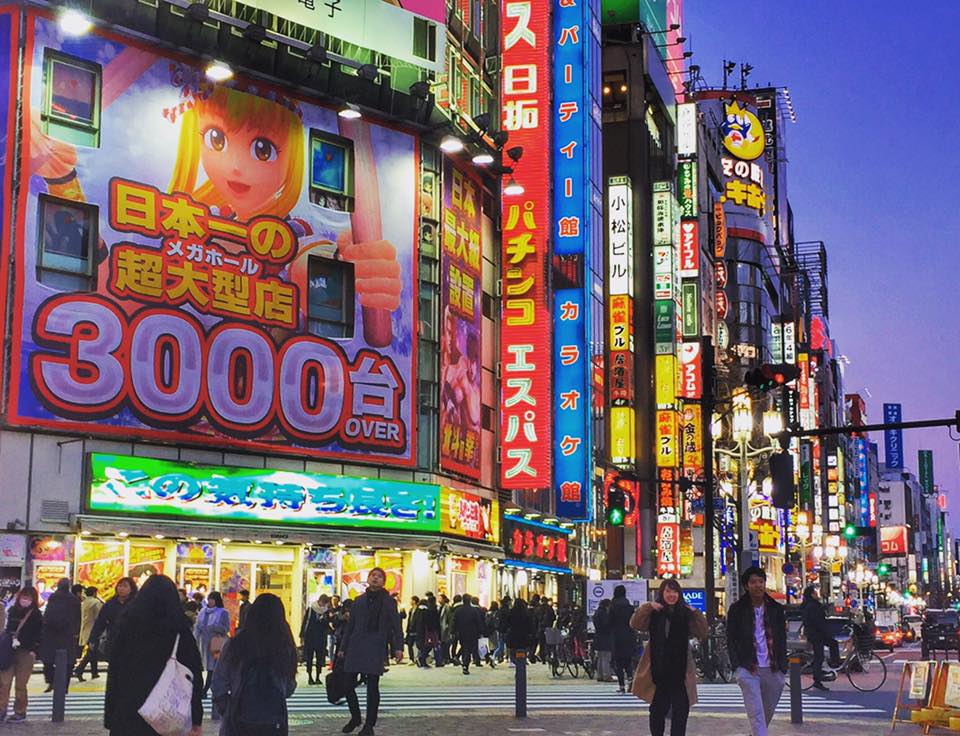
We check-in, take a shower, test heated toilets and head to busy streets of Shinjuku. The only goal tonight is to wander around and find a good restaurant for a dinner, and then place for a good drink. There are a lot of people in the streets, and all the area is illuminated and flashing. Promotional eye-catchers compete which one attracts your attention first. I don’t understand how anyone can even react to these signs, so many of them. The huge Godzilla, whose head stays above the skyscrapers, will certainly catch your eye. Especially when it’s lit up and opens its mouth. Our attention gets also the most illuminated restaurant in the neighborhood named Robot restaurant. In front of her gates, two giant robots dance to a simple song: “ROBOTO, ROBOTO, ROBOTO reee-stoooo-rant!” Unfortunately, we do not know what is happening in such a place, because the entrance fee they are asking for is too high, but the melodie “ROBOTO, ROBOTO, ROBOTO, reee-stooo-rant!” has stacked in our minds.

After a few hours of wandering around Shinjuku and arguing over which restaurant to choose, we finally enter the smallest one. It is just a small room with a kitchen bar for 7 people, behind which two Asians prepare food right in front of our eyes. When we sit down at the bar, the restaurant looks full already. We order a cup of warm sake as an aperitif, all ready for a Japanese culinary experience, when we suddenly find out that dishes from the daily menu are actually from Korean cuisine.☺ Never mind, two friends behind the counter cook great and we don’t regret our choice. Later, two more customers enter the room and this time the restaurant is really full. We all start to talk to each other, taste each other food and drink sake. Later in the night, when I roll into a cozy bed in my mini hotel room, I have to admit that I feel quite dizzy…

Perfect bed but little sleep. In a few hours, the next morning we all meet in the lobby. In the supermarket nearby we take something for breakfast and head to underground world. Again, I have to say, “thank you google maps!” The goal is the old part of Asakusa and the most famous temple in Tokyo – Senso-ji. Asakusa is famous for its cherry blossoms and old streets with traditional Japanese products and souvenirs. There are mainly stalls with Japanese sweets from rice dough such as mochi, kaminari-okoshi, ningyo-yaki or daifuku with traditional flavors such as green tea and sesame. You have to taste it! They taste great especially with a cup of green matcha tea. Personally, however, I can’t resist matcha ice-cream. The day just started, but I already enjoy my third.

The street leads to Senso-ji temples and the Skytree Tower, offering beautiful views of traditional Asakusa. Those who do not want to walk can pay a rickshaw, which is carried by fit Japanese with well muscled legs. It does not cost a little, but the guide in excellent English is included. There are many people in the temple, mostly Chinese and Japanese Buddhist believers. Some are dressed in traditional Japanese costumes, which can be rented for approximately 5,000 yen (40 euros) in the present shops. In a rented Geisha costume, you can take pictures and walk around the temple for an hour. We are most impressed by the fortune telling and the ritual around it. First, shake the metal container properly until you drop one bamboo stick. According to the drawn symbol on the stick, find the corresponding drawer with the same symbol. Here you will find a paper with your destiny. I pull out a happy fate. I can expect lots of traveling, money and love. However, my colleagues have a less fortunate hand. To really fulfill your destiny, you have to wrap the paper around the special hanger. If you aren’t happy about your fate, you must burn it. At least that’s what others do as I watch them. Travel, money and love… What more can I wish for? I hang the paper on the stand, absorb the incense fumes and we can happily return to Narita…


Zuzka Greizinger
STEWARDESS
FOLLOW ME